
Event
Agency Growth Summit – Speakers

Speakers


The Rise of Clientfishing – And What It’s Really Costing Agencies
“I keep hearing the same thing from agency leaders: we’re busier than ever, but it feels harder to grow,” says Alan Fitzsimons. “And when you dig into it, a huge amount of time is being lost long before work is ever won.”
Alan sits at the intersection of agency operations, growth, and delivery. As Global Events Lead at Teamwork.com, he works closely with hundreds of agency leaders across Europe and the US, and has spent the last decade in B2B SaaS, demand generation, and go-to-market roles focused on professional services and creative businesses.
“What we’re seeing right now is something different to normal pitching,” Alan explains. “Budgets are tighter, AI has raised expectations, and clients are shopping around more than ever – often without any real intent to switch. Agencies are giving away huge amounts of unpaid work just to stay in the conversation.”
In this session, Alan shares early insights from Teamwork.com’s upcoming 2026 Trends research, introducing the concept of Clientfishing, and why it’s becoming one of the biggest hidden drags on agency growth.
You’ll learn:
- Why more pipeline doesn’t always mean healthier growth
- How to spot ‘clientfishing’ before it drains your team and margins
- Practical ways agencies are protecting time, value, and people — without killing momentum
“This isn’t about winning fewer clients,” Alan says. “It’s about winning the right ones — and building a growth engine that doesn’t burn out your team in the process.”
The Anatomy of a Deal – And How to Avoid a Bad One
“I’ve spoken to three or four founders recently who were centimetres away from a bad deal,” says Simon Penson. “It’s easy to say yes when someone offers to ‘take the pain away’ – but that’s when you lose something very valuable.”
Simon knows the M&A game inside out. As founder of Scaled, he’s guided dozens of agency leaders through the deal-making minefield. His warning? Don’t let desperation or flattery dictate your exit.
“In agency land, you’re seeing a lot of so-called roll-ups right now,” he explains. “They promise scale and simplicity, but if you don’t understand how those deals are structured, you can end up locked into terms that work brilliantly for the buyer – and terribly for you.”
In this talk, Simon will unpick how roll-ups and other deals really work:
- The red-flag deal structures that undervalue your agency.
- What a fair earn-out looks like – and why most fail.
- How to protect yourself with smart advice.
“I want to arm founders with the knowledge to say, ‘Actually, no thanks – that’s not a good deal.” Simon says.
Agency Grow-Getters: How to Plan For Scalable Growth
“Most agencies are set up out of passion. The goal is simple: do great work, with great people, and earn enough money,” says Jay Neale, MD at Agency Works. “But when that passion business starts to scale, everything changes.”
At first, agency life feels fun and free – a little rock ‘n’ roll. Then the calendar fills, payroll grows, and suddenly you’re juggling mortgages, not just projects.
“When you multiply by three, things change – and it gets tougher,” Jay says.
In this hands-on, interactive workshop, Jay helps you take the guesswork out of growth. You’ll learn the phases of agency growth, the five pillars that make a business scalable, and how to build (and actually use) a practical growth plan.
Forget winging it. This is where you’ll map out what structure, process, and leadership looks like at your next stage of growth.
If you’re serious about scaling sustainably, and profitably, this is where your plan starts.
The Talent Pipeline Behind Agency Growth
“Every hire counts,” says Kate Higham. “The quality of talent and the timing of them entering your business is the thing that can make or break you.”
Kate knows this the hard way. When Born Social was acquired by Croud in 2022, the agency was around 70 people. Three years later, it’s close to 200 — with whole new teams, a fast-growing US arm, and a completely different operational reality.
And throughout that period of growth, one truth became clear: You can’t scale revenue if you can’t scale talent.
“Most agencies don’t know when to hire, or how,” Kate says. They wait too long. They rely on freelancers. They panic-hire. Or they bring in someone with the wrong mindset, and “it can really mess up the whole agency.”
To avoid that, Kate built a talent engine long before Born needed it – a set of always-on pipelines designed to find great people before the job opens up.
She calls them Silver Medalists (“final interview candidates we loved but didn’t hire”), Heartbreakers (“the ones who rejected us … and sometimes come back”), and Diamonds in the Rough (“not ready yet, but there’s something special there”).
Layer that with headcount forecasting, culture design, and a clear sense of what “good” looks like at each stage of growth – and you get an agency that can triple in size without breaking.
If your agency wants to grow sustainably, and not chaotically, this is the session you don’t want to miss.

Inside the Deal: The Human First Acquisition
“How do you pull off a successful acquisition?”
That’s the question Becky Simms has been striving to answer.
Becky is the founder and CEO of Reflect Digital and now leads the Human First Collective – a 75-person group that recently acquired Freestyle into LAB. This wasn’t a dry, numbers-only deal. “Our motivation was about bringing brilliant people together,” she says. Of course, the clients matter. But the starting point was the humans.
In this session, Becky lifts the lid on what really happens when one agency buys another – especially for the team that’s being acquired. Freestyle had around 15 people, tight with their founders, some with decade-long tenure. Then, in the space of a single announcement, their working lives changed.
Becky shares the human side of that moment: why you can’t loop the team in too early (“there’s still a chance it all falls out on the day of signing”), and how they tried to make the news land as well as it could. From an FAQ doc, and an “about us” deck, to a first 15-minute ‘hello’ call and a deeper in-person session the following Monday – some choices people loved, others they ‘really hated’.
“You also will never please everybody,” Becky says. “The best you can do is be clear on your values, honest in your comms, and give people a fair fresh start.”
If you’re planning to buy, sell, or just survive an acquisition – this session will help you think it through with more clarity and compassion. Becky shows that growth doesn’t have to mean chaos, and that you can make big moves while still keeping people feeling seen, steady, and supported.
Building a Lifestyle Agency Intentionally
“I really believe I’ve grown the perfect lifestyle business.”
That’s how Gareth Hoyle describes Marketing Signals – a 30-person, fully remote agency turning over £2 million, all while working a 4-day, 32-hour week. And crucially, without the stress that normally comes with running an agency.
Gareth didn’t stumble into this. He built it deliberately.
“I don’t currently know what my team are up to,” he explains. “But I’ve put processes in place so that I can measure my teams’ output.” He explains. That clarity means he no longer has to be involved in everything. A strong leadership team runs the engine, while Gareth focuses on steering the ship rather than paddling it.
And while plenty of founders talk about wanting balance, Gareth actually lives it. “I’m not stressed,” he says plainly. For him, this isn’t about being “anti-growth”. It’s about choosing a model that works for the business and the person running it.
His question for agency owners is simple: “If you’re getting stressed trying to grow your agency to sell, and it’s making you ill, why are you doing it?”
In this session, Gareth will break down the decisions, systems, and mindset shifts that allowed him to build a calm, profitable agency, without sacrificing ambition. If you’re tired of the grind and want to design an agency that serves your life – not consumes it – this session is for you.

5 Case Studies That Taught Me All I Know About Agency Growth
“It took me four or five years to get the first project over the line, and most people would have given up.”
Ryan Hall, Founder of Friday Solved, has the receipts.
In this session, Ryan isn’t bringing a tidy framework or a polished ‘sales playbook’. Instead, he’s telling the stories behind the deals that shaped his career – the ones that were messy, slow, painful, and eventually transformative.
Like the client relationship that dragged on through multiple marketing director changes before turning into a million-pound-a-year retainer. Or another client that won Ryan a £26m win not from one big pitch, but from ten years of relationship building, credibility stacking, and knowing when to “take money off the table”.
“Agencies think sales is something you can wake up and do for a day,” Ryan says. “But it’s actually something you need to work on every single day. It’s a constant process.”
Across five case studies, including some big-name clients, Ryan breaks down the real lessons behind growth: why follow-up matters more than brilliance, why understanding a client’s business beats any deck, and why doing ‘the right things’ consistently matters more than chasing quick wins.
This session is loaded with real-life deals that involve long timelines and battle scars – the kind of sales truths you only get by staying in the game.
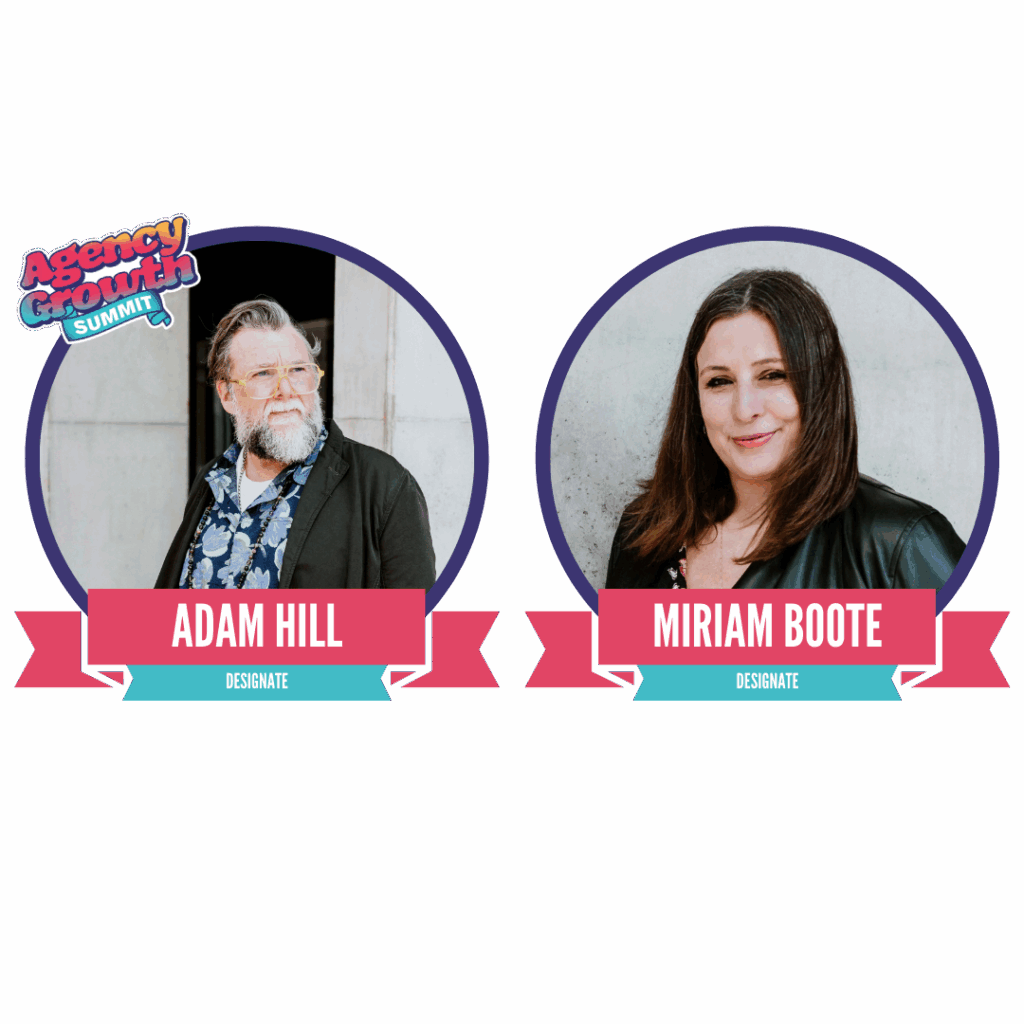
Independence by Design: Saying No, Starting Over, and Passing the Torch
“Every time I thought about selling, it just felt cold. It failed me every time,” says Adam Hill, Designate Founder, reflecting on three decades of politely sidestepping acquisition offers.
While many agencies chase an exit, Adam spent 33 years doing the opposite – building an independent shop he wasn’t willing to hand over. “Clients love our independence. They celebrate it,” he says. And that belief shaped everything: how the agency grew, how it restructured, and how it survived the market’s weirdest years.
At its peak, Designate was 65 people across three divisions. Today, it’s leaner at 19 people – by choice. “We’re in that mode of wanting really good people, and supporting AI with good brains,” Adam explains. Independence wasn’t a romantic ideal; it was a strategic tool. It let them pivot, shrink, rebuild, and stay fluid when everyone else was panicking.
And woven through all of this is the agency’s most defining story: Miriam Boote, who joined as an account executive nearly 20 years ago, rose to MD and there’s no stopping her any time soon. “She’s earned her way here,” Adam says. “It’s a lovely story – taking someone who built the business with you and recognising it properly.”
Adam and Miriam will share how resisting acquisition, rebuilding through chaos, and handing ownership to the person who earned it shaped the agency’s growth.

FAQ
Event FAQs